Mon to Fri, 8:00am to 5:00pmUtalii Court, Gesora Road, Nairobi

+254 184 379 590+254 719 450 317 Altinfo@gstechguard.co.ke

Number plate recognition · ticketing · reports

Parking Management and ANPR Systems in Kenya

We design and install parking management systems in Kenya for malls, offices, hospitals, estates and private car parks. Number plate cameras, tags or tickets control each lane, boom barriers keep traffic orderly, and the software tracks every vehicle, visit and payment.

  • ANPR cameras with honest accuracy expectations
  • Tickets, tags and visitor passes in one system
  • Reports that show occupancy and revenue
Camera pole overlooking a car park that uses parking management systems with plate recognition

A busy car park can lose money and goodwill in small ways: drivers who never pay, tickets that disappear, staff who wave friends through and queues that back onto the road. Parking management systems fix these leaks. They control each lane, record every vehicle and give owners clear numbers to manage with.

Good parking management systems also help with safety, because guards know which cars are on site during an emergency. This page explains what a system includes, how number plate recognition works and where it fails, how ticketing and tags fit in, and what reports you get.

Gates and parking

What parking management systems include

A complete system has hardware at each lane and software that ties everything together.

Part Job
Boom barrier Physically controls each entry and exit lane
Loop detectors Sense vehicles so barriers open and close safely
ANPR camera Reads number plates for automatic entry and records every visit
Ticket dispenser or tag reader Issues tickets to visitors or reads tags for regular users
Pay station or cashier point Takes payment before exit
Intercom Lets drivers call for help at any lane
Management software Holds user lists, tariffs, reports and images

The barrier side is covered in detail on our boom barrier installation page. Here we focus on the parts that make parking management systems smart.

Coverage

ANPR: how number plate recognition works and where it fails

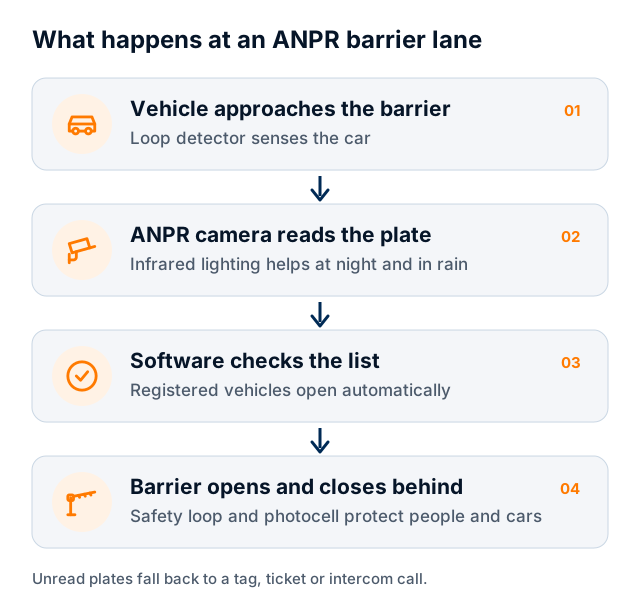
Automatic number plate recognition (ANPR) uses a camera tuned to read plates. When a car stops at the barrier, the camera captures the plate, software converts it to text, and the system checks it against a list. If the plate is registered, the barrier opens. Either way, the image and time go into the log.

With a well-positioned camera and clean, standard plates, good systems read most plates correctly on the first attempt. Still, every lane needs a fallback, such as a tag, a ticket or an intercom call to a guard. We design that fallback into every lane, so a misread never strands a driver.

Sequence at an ANPR barrier lane from approach to barrier closing
ANPR lanes always need a fallback for plates the camera cannot read.

Parking Management & ANPR

Ticketing, tags and visitor flow

Most sites mix several groups of drivers, and each group expects a smooth entry. The trick is to give every group a clear route without adding guards.

Different drivers need different ways in. Good parking management systems handle all of them in one database.

We also plan the physical flow. For example, separating entry and exit lanes reduces conflict, and a short waiting bay before the barrier stops queues spilling onto the road.

CCTV

Camera placement for reliable plate reading

Most ANPR problems start with the camera position, not the software. So we follow a few simple rules on every lane.

  • Distance: the camera sits a few metres from the stop line, close enough for a sharp plate image.
  • Angle: we keep the angle shallow, because steep angles stretch the characters.
  • Height: a low mounting height reduces glare from headlights and rain on the lens.
  • Lighting: infrared light helps at night, while a hood blocks low sun in the morning and evening.
  • Speed: a stop line or speed bump slows cars down, which gives the camera more time.

In addition, we test the lane at different times of day before handover. For instance, a camera facing east can read well at noon but struggle at 7 a.m. Testing early finds those problems while the installer is still on site.

Automatic boom barrier at a road entry

Parking Management & ANPR

Payment and revenue control

Also, for paid car parks, the system calculates the fee from entry and exit times using your tariff. Drivers pay at a pay station, a cashier window or, where supported, by mobile money. The exit lane then opens only for paid tickets or plates.

This closes the most common gaps. As a result, cashiers cannot pocket fees for unrecorded cars, and lost-ticket claims become easy to check against plate images. Owners usually see the difference in the first monthly report.

Parking Management & ANPR

Reports you receive

Parking management systems produce data you can act on:

  • live occupancy, so guards can close the entrance when the car park is full;
  • entries and exits by hour, day and lane;
  • average stay and peak times, to set fair tariffs;
  • revenue by cashier, shift and payment method;
  • images of every plate, for disputes and incidents.

Reports export to Excel, and many systems can email a daily summary to management.

CCTV

Integrating with CCTV and access control

Parking areas are also a common place for theft and damage, so parking management systems work best alongside general cameras. So we position general CCTV installation views to cover rows of parked cars, pay stations and pedestrian exits, in addition to the plate cameras. For staff car parks, the same cards used on office doors can open the barrier through our access control system.

How it works

Installing parking management systems

  1. Survey. We study traffic flow, lane widths, lighting, power and where drivers queue at peak times.
  2. Design. Next, we plan lanes, camera angles, barrier sizes and the fallback for every lane.
  3. Civil and cabling. Our team lays ducts, cuts loops and runs power and network cables.
  4. Install. Then we mount barriers, cameras, dispensers and intercoms.
  5. Configure. After that, we load tariffs, user lists and reports.
  6. Train. Finally, guards and cashiers learn daily tasks and how to handle exceptions.

Power backup is part of every design, because a car park that stops at an outage blocks the whole site. Our UPS power backup team sizes the battery for barriers, cameras and the server.

Maintaining the system

Lanes run all day, so small faults add up quickly. We recommend quarterly service visits that clean camera lenses, test loops and photocells, check barrier balance, update software and review error logs. During each visit we also read a sample of recent plate images, which shows whether accuracy is slipping before drivers start to complain. Spare ticket rolls, tags and printer parts should stay on site, and we help you keep a simple stock list.

Privacy and data

Plate images and visit records are personal data. Keep them only as long as you need them, restrict who can search them and display notices at the entrance. The Office of the Data Protection Commissioner explains the duties that apply. We configure retention periods and user rights to match your policy.

Costs and pricing

Cost factors for parking management systems

Prices depend on the number of lanes, whether you need ANPR, ticketing or both, payment options, civil work and software licences. A simple two-lane system with tags and ANPR is a very different project from a mall with six lanes and pay stations. We quote after a survey, and we can phase the work, starting with barriers and tags and adding ANPR or payments later. See the security systems price guide for wider context, or request a quote to start.

Get started

Book a site survey

Tell us about your site and an engineer will call you back within one working day to discuss your needs and arrange a visit.

  • Clear, itemised written quote
  • Security, network, fire and power from one team
  • Support and maintenance after handover

Prefer to talk? Call +254 184 379 590

We reply within one working day. Or call +254 184 379 590.

Frequently asked questions

How accurate is number plate recognition?

With good camera placement, standard clean plates and controlled lighting, modern ANPR reads most plates correctly on the first try. Accuracy drops with dirty or damaged plates, decorative fonts, glare and heavy rain. That is why every lane we design has a fallback such as a tag, ticket or intercom.

Can the system charge for parking?

Yes. The software calculates fees from entry and exit times using your tariff. Drivers pay at a pay station or cashier point, and the exit barrier opens only for paid tickets or plates. Reports then show revenue by shift, cashier and payment method.

Can residents use tags while visitors use tickets?

Yes. One system can handle several user types. Residents or staff use tags or registered plates, visitors take tickets or have their plate logged, and contractors get time-limited access. All of it appears in the same reports.

What happens when the camera cannot read a plate?

The lane falls back to another method. Drivers can use a tag, take a ticket or call the guard on the lane intercom. The guard sees the plate image and can open the barrier, and the system still logs the visit.

Areas we serve

Installed and supported across Kenya

Our Nairobi team travels to sites countrywide. Choose your town for local details.

Planning a project or fixing a fault?

Tell us about the site. We will arrange a survey, give you a clear written quote and explain the options in plain language.

CallWhatsAppAsk usQuote