Mon to Fri, 8:00am to 5:00pmUtalii Court, Gesora Road, Nairobi

+254 184 379 590+254 719 450 317 Altinfo@gstechguard.co.ke

Wireless bridges · line-of-sight surveys · alignment

Wireless Point-to-Point Links Between Buildings

We design and install wireless point-to-point links in Kenya that connect buildings, gate houses, warehouses and remote sites without digging trenches. Each link starts with a line-of-sight survey, uses business-grade radios, and comes with alignment records, encryption and monitoring.

  • Line-of-sight survey and link budget first
  • Encrypted, monitored business-grade radios
  • Ideal where trenching is costly or impossible
Network engineer checking link data on a tablet while planning wireless point-to-point links

Sometimes the network needs to reach a place that cables cannot easily go. A road separates two buildings. A warehouse sits 600 metres across a yard. Or a gate house needs cameras and an intercom, but the driveway is newly paved. In these cases, wireless point-to-point links can carry fast, stable data through the air, often installed in a day or two.

This page explains when a wireless bridge makes sense, how we survey and plan each link, how installation and alignment work and how we keep links reliable.

Wi-Fi

A wireless bridge is not always the answer. However, it often beats the alternatives on cost and speed, especially across roads and open yards.

Situation Wireless link Fibre
Crossing a public road Usually simple Needs wayleave and road works
Distance of 200 m to 10 km Practical with line of sight Costly civil work
Temporary or rented site Easy to remove and reuse Sunk cost
Very high capacity (10 Gbps+) for many years Possible but costly Usually best
No clear line of sight Not suitable without relays Works if a route exists

Distance alone does not decide it. A 300-metre link across a busy road may justify a radio, while a 300-metre link across your own garden may be cheaper with a shallow trench. So we price both options where it makes sense.

Typical uses include linking a head office to a warehouse, connecting gate houses and fence-line cameras, joining apartment blocks in an estate, extending a network to a farm office, and providing a backup path beside fibre.

Costs and pricing

Radio links need a clear path. Not just a straight line between antennas, but a clear zone around that line called the Fresnel zone. Trees, roofs, water tanks and even future buildings can block it. That is why every project starts with a survey.

  1. Map the path. We plot both ends, check distance and elevation and look at satellite images.
  2. Visit both sites. Next, we climb to the planned mounting points and confirm the view.
  3. Check obstacles. We look for trees that will grow, planned construction and metal structures.
  4. Scan the radio spectrum. Then we measure interference on candidate channels.
  5. Calculate the link budget. This compares transmit power, antenna gain and path loss with the receiver's needs, plus a safety margin for rain and dust.
  6. Recommend hardware. Finally, we choose radios, antennas and mounting height to meet the target speed with margin.

If the path is blocked, options include a taller mast, a relay point on a third building, or fibre for part of the route.

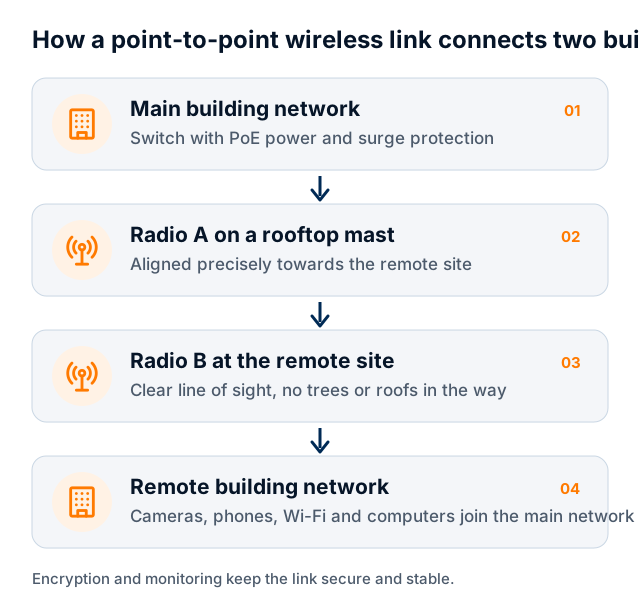
Diagram of a wireless point-to-point link connecting two buildings
A wireless bridge joins two networks over a clear line of sight.
Ceiling-mounted Wi-Fi access point in an office

How it works

Good mounting is what keeps wireless point-to-point links stable for years. We install radios on solid poles or brackets, braced against wind, and earth every mast for lightning protection. Cable entries are weather-sealed, and surge protectors guard the switch at each end.

Alignment then fine-tunes the link. We adjust each antenna in small steps while watching signal strength, until both ends reach the planned level. After that, we tighten every bolt, record the final readings and photograph the installation for your records.

Timing

Speed, distance and frequency

The right radio depends on how far, how fast and how important the link is. So we balance these three factors rather than picking the most powerful model.

Most business links use licence-exempt bands in the 5 GHz and 60 GHz ranges, or licensed bands for critical long links. The choice affects distance, speed and resistance to interference.

  • 5 GHz radios are versatile, with good range and speeds from 100 Mbps to over 1 Gbps.
  • 60 GHz radios deliver very high speeds over short distances, usually under 1 km, and suffer more from heavy rain.
  • Licensed microwave links offer protected channels for critical connections over long distances.

Radio equipment used in Kenya should be type-approved by the Communications Authority of Kenya, and some frequencies need a licence. We advise on these points during the design.

Wi-Fi

Business radios from makers such as Ubiquiti and MikroTik report signal strength, noise and throughput. We set up monitoring so we see when a link weakens, which often points to a shifted mount or a new obstacle.

In addition, we enable encryption on every link, so nobody can listen in on your data.

Rain affects higher frequencies most. A well-designed 5 GHz link with proper fade margin keeps running through typical Kenyan rain. 60 GHz links can lose speed in heavy downpours, which is why we often pair them with a 5 GHz backup. Dust and haze have little effect when the link budget includes a healthy margin.

Maintenance after installation

Radios need little attention, yet a short check every six months keeps links healthy. During each visit, we confirm signal levels against the original readings, tighten mounts after windy seasons, inspect cable seals and earthing, and update firmware. If readings drift, the cause is usually simple: a tree has grown, a bracket has shifted or water has entered a connector. Catching that early prevents a sudden outage. Also, monitoring alerts often show a problem before anyone on site notices slower speeds.

Common problems

Common uses on Kenyan sites

  • Estates and apartments: connecting gate houses, blocks and management offices for cameras, intercoms and Wi-Fi.
  • Warehouses and factories: linking offices, stores and weighbridges across large compounds.
  • Schools and campuses: joining hostels, labs and admin blocks.
  • Farms and agribusiness: bringing the network to packhouses and remote offices.
  • CCTV coverage: carrying camera feeds from distant fence lines. See our remote CCTV options.

Costs and pricing

The cost depends on distance, required speed, frequency band, mast height, the number of links and redundancy. A short building-to-building link is a modest project, while a multi-kilometre licensed link costs much more. We give a firm quote after the survey, with a clear explanation of the expected speed and reliability.

How it works

To prepare a design quickly, share the address or map pin of both sites, the approximate distance, the services the link will carry and the speed you expect. Photos from the roof or the highest point at each end help a lot, because they show trees and buildings along the path. Also tell us whether the link is critical. A link that carries a few cameras needs a different design from one that carries a whole office and its phone system. With these details, we can often confirm feasibility before the site visit and arrive with suitable hardware to test on the day.

Wi-Fi

Wireless or fibre?

If you can trench easily and need the link for many years, fibre optic installation is often the long-term winner. However, when roads, rented land or time get in the way, wireless point-to-point links are the practical choice. We design both and will tell you honestly which suits your site. For more about building a complete network, see network infrastructure services.

Why choose us

Why choose GS TechGuard

  • Survey and link budget before any quote.
  • Proper masts, earthing and surge protection.
  • Encrypted, monitored links with recorded alignment.
  • One team that also installs the cameras, Wi-Fi and switches at each end.

To plan wireless point-to-point links for your site, request a survey and share the two locations you want to connect.

Get started

Book a site survey

Tell us about your site and an engineer will call you back within one working day to discuss your needs and arrange a visit.

  • Clear, itemised written quote
  • Security, network, fire and power from one team
  • Support and maintenance after handover

Prefer to talk? Call +254 184 379 590

We reply within one working day. Or call +254 184 379 590.

Frequently asked questions

How far can a wireless bridge reach?

With a clear line of sight, business radios can link sites from a few hundred metres to well over 10 kilometres. Practical distance depends on frequency, antenna size and the speed you need. Short 60 GHz links suit distances under about 1 km, while 5 GHz and licensed links cover much longer paths.

Does rain affect the link?

Heavy rain mostly affects higher frequencies such as 60 GHz, which may slow down during a storm. A properly designed 5 GHz link with enough fade margin keeps running in normal Kenyan rain. For critical links, we combine bands so the connection falls back automatically.

Do I need a licence for a wireless link?

Many business links use licence-exempt bands, as long as the equipment is type-approved and used within power limits. Long or critical links may use licensed frequencies, which require an application to the Communications Authority of Kenya. We advise on the right option during design.

Is a wireless link secure?

Yes, when set up properly. We enable strong encryption, change default passwords, update firmware and limit management access. The narrow beam of a point-to-point link also makes it hard to intercept compared with ordinary Wi-Fi.

Areas we serve

Installed and supported across Kenya

Our Nairobi team travels to sites countrywide. Choose your town for local details.

Planning a project or fixing a fault?

Tell us about the site. We will arrange a survey, give you a clear written quote and explain the options in plain language.

CallWhatsAppAsk usQuote