Mon to Fri, 8:00am to 5:00pmUtalii Court, Gesora Road, Nairobi

+254 184 379 590+254 719 450 317 Altinfo@gstechguard.co.ke

Voice alarm · zoned messages · PA integration

Emergency Voice Evacuation Systems in Kenya

We design and install voice evacuation systems in Nairobi and across Kenya for hotels, malls, hospitals, campuses, offices and places of worship. Recorded messages play automatically when the fire alarm triggers, zone by zone, and trained staff can make live announcements to guide people out calmly.

  • Clear recorded and live messages, zone by zone
  • Linked to the fire alarm panel
  • Background music and paging on the same speakers
Audio equipment rack used for voice evacuation systems in a Nairobi building

When a bell rings in a busy building, many people wait. They look around, assume it is a test or a false alarm, and carry on. Precious minutes pass. A clear spoken message changes that behaviour. "Attention please. An emergency has been reported in the building. Please leave by the nearest exit." People understand what is happening and what to do. That is the core idea behind voice evacuation systems.

This page explains what voice evacuation adds to a bell alarm, how zoning and messages work, how the system connects to the fire alarm and PA, and when you should consider one.

Fire safety

What voice evacuation adds to a bell alarm

A bell or siren says "something is wrong". Voice says what is wrong and what to do. That extra information brings real benefits.

Feature Bell or siren Voice evacuation
Message Tone only Clear instructions in one or more languages
Zones Usually the whole building Different messages for different areas
Phased evacuation Hard to manage Simple: evacuate one floor, alert the next
Live announcements Not possible Staff can guide people in real time
Everyday use None Paging and background music on the same speakers
Visitor response Often slow Usually faster and calmer

Voice also reduces panic. A calm voice with a clear instruction gives people something to do, which is far better than a loud tone and uncertainty. In addition, staff can give updates, for example telling people which stair to avoid.

In buildings full of visitors who do not know the layout, such as hotels, malls and hospitals, voice evacuation systems make the biggest difference.

Voice Evacuation Systems

Zoning and message design

Zones divide the building so different areas hear different messages. For example, during a fire on the third floor of a hotel, guests on that floor hear "please leave now", the floors above and below hear an alert message, and the restaurant hears a calm advisory. This is called phased evacuation, and it keeps stairs from overcrowding.

We record messages with you and agree the wording with your fire safety team before commissioning.

Fire safety

Integration with fire alarm and PA

Voice evacuation systems connect directly to the fire alarm panel. When a detector or call point triggers, the panel tells the voice system which zone is affected. The voice system then plays the right message in each zone automatically. Meanwhile, a fireman's microphone at the control point lets staff take over with live instructions.

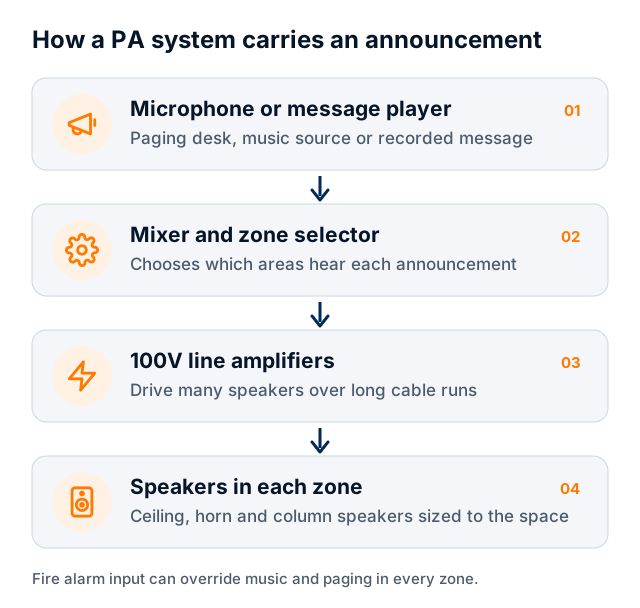
Because the speakers serve daily needs too, the same system handles paging and background music. During an emergency, the fire signal overrides everything else, so music and announcements stop at once. Our public address systems page explains speaker and amplifier design, and our fire alarm installation team handles the panel side.

Diagram showing how a PA system carries announcements from microphone to speakers
The fire alarm input overrides music and paging in every zone.
Technician in a hard hat fitting a ceiling fire alarm device

Voice Evacuation Systems

Designing for speech clarity

However, a message that people cannot understand is useless. Echo in large halls, noise from machinery and poorly placed speakers all reduce clarity. Therefore we design voice evacuation systems for intelligibility, not just loudness.

  • Speaker spacing: more, smaller speakers usually beat a few loud ones.
  • Speaker type: ceiling speakers for offices, horns for noisy areas, column speakers for halls.
  • Room acoustics: hard surfaces cause echo, so we adjust speaker positions and levels.
  • Testing: during commissioning, we measure sound levels and check speech clarity in each zone.

Resilience: cables, amplifiers and power

An evacuation system must keep working during the fire it warns about. For this reason, the design uses fire-resistant cable to speakers, monitored speaker lines that report faults, and standby amplifiers that take over if one fails. In addition, batteries keep the system running for the required time after mains failure. The control equipment usually follows standards such as EN 54-16, with system design guided by BS 5839-8.

Is voice evacuation required?

Requirements depend on the type of building, its size, its use and the standards your designer, insurer or authority follow. In many large public buildings, hotels, hospitals and malls, voice evacuation is expected or strongly recommended. In smaller offices, a conventional sounder system is often enough. Your fire safety consultant or fire safety audit will show what applies to your premises. We can then design the system to suit.

Audio

Can existing PA speakers be used?

Sometimes. Existing speakers can be reused if they are in good condition, cover the right areas and are wired on cable that can be made fire-resistant. However, many older PA systems use ordinary cable and amplifiers without monitoring or backup power. In that case, we usually recommend a proper voice evacuation upgrade, while reusing what we safely can.

How it works

Our installation process for voice evacuation systems

  1. Survey. We study the building, its zones and its existing alarm and PA equipment.
  2. Design. Next, we plan zones, speaker types and positions, amplifiers, cabling and messages.
  3. Install. Our technicians install fire-resistant cabling, speakers, amplifiers and the control unit.
  4. Integrate. Then we connect the fire alarm panel, music sources and paging microphones.
  5. Commission. We test every zone, measure sound levels and confirm messages and override work.
  6. Train. Finally, staff learn live announcements, fault indications and weekly tests.
Safety officers checking fire extinguishers on a warehouse floor

Fire safety

Training staff to use voice evacuation systems

Safety officer ticking a checklist beside red fire suppression cylinders

Technology works best when people know their role. So we train two groups at handover. First, fire marshals and security staff learn how to start an evacuation manually, how to make a live announcement and how to read fault lights. Second, reception and management learn how phased evacuation works, so they know why some floors hear an alert rather than an evacuation message. We also suggest a short script for live announcements, because people under pressure speak too fast. A calm, prepared voice helps everyone move steadily towards the exits.

We recommend practising during fire drills. Each drill tests the messages, the zones and the people, and it shows where instructions need to be clearer.

Maintenance

Like any life safety system, voice evacuation needs regular checks. We suggest a weekly test with the fire alarm, and a professional service every six months that checks speakers, amplifiers, batteries, line monitoring and message playback. Our fire alarm maintenance plans can include voice evacuation.

Upgrading from a bell system

Many buildings start with sounders and later add voice. The upgrade can be phased. For example, public areas such as lobbies, restaurants and halls can move to voice first, while back-of-house areas keep sounders until the next budget cycle. The fire panel then drives both. In addition, we can often reuse cable routes and containment from the old PA, which lowers the cost of the change.

Costs and pricing

Cost factors

The cost of voice evacuation systems depends on the number of zones, speakers, amplifier power, fire-resistant cabling, integration with the fire alarm and how much existing equipment we can reuse. We quote after a survey. For the wider fire protection picture, see our fire safety systems overview.

Guidance on fire safety duties for employers is available from the Directorate of Occupational Safety and Health Services. To plan voice evacuation systems for your building, request a site survey.

Get started

Book a site survey

Tell us about your site and an engineer will call you back within one working day to discuss your needs and arrange a visit.

  • Clear, itemised written quote
  • Security, network, fire and power from one team
  • Support and maintenance after handover

Prefer to talk? Call +254 184 379 590

We reply within one working day. Or call +254 184 379 590.

Frequently asked questions

Is voice evacuation required?

It depends on the building's type, size and use, and on the standards your designer, insurer or authority follow. Large hotels, hospitals, malls and public buildings often need or strongly benefit from voice evacuation, while small offices usually manage with sounders. Your fire safety consultant or audit will confirm what applies.

Can existing PA speakers be used?

Sometimes. Speakers in good condition that cover the right areas can often be reused if the cabling can be made fire-resistant and the lines monitored. Many older systems lack monitoring and backup power, so they need an upgrade. We assess what can be safely reused during the survey.

Can we play background music on the same system?

Yes. Voice evacuation systems usually handle paging and background music every day. When the fire alarm triggers, the emergency signal overrides music and paging immediately in every zone, and the right message plays automatically.

Can messages be in English and Kiswahili?

Yes. We can record messages in English, Kiswahili or other languages your visitors use. Many sites play a short message in both languages one after the other. We agree the final wording with your fire safety team before commissioning.

Areas we serve

Installed and supported across Kenya

Our Nairobi team travels to sites countrywide. Choose your town for local details.

Planning a project or fixing a fault?

Tell us about the site. We will arrange a survey, give you a clear written quote and explain the options in plain language.

CallWhatsAppAsk usQuote