
Baggage screening · metal detectors · operator training
X-Ray Baggage Scanners and Security Screening in Kenya
We supply, install and support X-ray baggage scanners in Kenya for hotels, malls, event venues, offices and institutions. We help you choose the right tunnel size, plan the screening point so queues keep moving, train your operators and keep the equipment in service.
- Scanner size matched to your bags and visitor numbers
- Walk-through and handheld metal detectors
- Operator training and service visits

Bag checks by hand are slow, inconsistent and uncomfortable for guests. A guard can only open so many handbags before the queue reaches the car park. X-ray baggage scanners solve that. Bags pass through a tunnel, an operator sees what is inside on a screen, and only suspicious items need a closer look.
This page explains how to choose screening equipment, how we plan a screening point, what training operators need and how we keep machines running. It also sets out clearly what GS TechGuard supplies and what we install, so you know exactly what you are buying.
Displays
Which screening equipment suits your entrance?
Most screening points use three tools together. Each one covers a different risk.
| Equipment | What it finds | Typical use |
|---|---|---|
| X-ray baggage scanner | Weapons, tools, liquids and suspicious shapes inside bags | Hotels, malls, offices, courts, events |
| Walk-through metal detector | Metal items carried on the body | Every busy screening point |
| Handheld metal detector | Pinpoints metal found by the walk-through unit | Secondary search table |
| Under-vehicle mirror or camera | Items hidden under cars | Vehicle gates at high-risk sites |
Not every site needs all of them. For example, a small office may only need a walk-through detector and a handheld wand. However, a mall with thousands of visitors a day will want X-ray baggage scanners at each main entrance, because hand checks simply cannot keep up.
X-Ray Baggage Scanners
X-ray baggage scanner sizes and use cases
Scanners are described by their tunnel opening, in centimetres. The tunnel must fit the largest bag you expect to screen.
| Tunnel size (approx.) | Suits | Typical sites |
|---|---|---|
| 50 × 30 cm | Handbags, laptop bags, small parcels | Office receptions, banks, small hotels |
| 60 × 40 cm | Backpacks and medium luggage | Hotels, malls, hospitals, courts |
| 65 × 50 cm | Carry-on suitcases | Large hotels, event venues |
| 100 × 100 cm | Large luggage and cargo | Transport hubs, warehouses, mail rooms |
Beyond size, a few features matter in daily use:
- Dual-energy imaging colours items by material, so organic, mixed and metal items look different.
- Image tools such as zoom, edge enhancement and colour filters help operators judge a shape quickly.
- Threat image projection inserts test images to keep operators alert during quiet hours.
- Conveyor speed and belt load decide how many bags per hour the unit handles.
- Network export lets you save images for incident reviews.
We match these features to your visitor numbers rather than selling the biggest machine on the list.
How it works
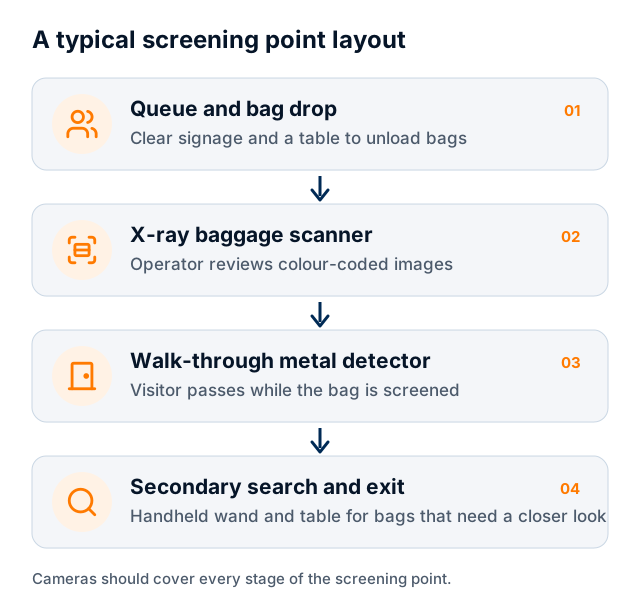
Planning the screening point
A good layout matters as much as the equipment. Poor layouts cause queues, missed bags and arguments at the door.
- Measure the space. We check the entrance width, ceiling height, floor strength and power points.
- Set the flow. Visitors should move in one direction: drop the bag, walk through the detector, collect the bag.
- Add tables. A loading table before the scanner and a collection table after it stop bags piling up.
- Place the search area. Next, we place a secondary search table to one side, so checks do not block the line.
- Plan cameras. Then we position CCTV to cover every stage, which protects both guests and staff.
- Plan power. Finally, we add a UPS so the scanner shuts down safely or keeps running during an outage.
For most hotels and malls, one lane of X-ray baggage scanners handles a few hundred bags an hour. Busy venues plan extra lanes for peak times.
X-Ray Baggage Scanners
Walk-through and handheld metal detectors
A walk-through detector is an arch with sensor panels. It signals when a person carries metal above a set level, and multi-zone models show roughly where on the body the item sits. We install, level and calibrate each arch, then set the sensitivity to match your risk and your visitors. For instance, a courthouse sets a higher level than a shopping mall.
Handheld wands then confirm the exact location. They are cheap and portable, so we recommend at least two per screening point, plus spare batteries.
How it works
Installation, radiation safety and operator training
X-ray baggage scanners use low-dose X-rays inside a shielded tunnel. When installed and maintained correctly, the dose outside the tunnel is very low. Even so, the law treats them as radiation equipment. In Kenya, the Kenya Nuclear Regulatory Authority (KNRA) regulates radiation sources and facilities that use them, including baggage scanners. Facility owners should confirm the current registration and licensing steps directly with KNRA before installation, because rules and fees change.
Training is just as important. Even the best X-ray baggage scanners miss threats when an operator is tired or unsure. Operators learn to read images, spot common threats and use the image tools. Supervisors learn daily start-up checks and what to do when the machine raises a fault. We keep training practical and short, and we offer refresher sessions when staff change.
X-Ray Baggage Scanners
Choosing a supplier for X-ray baggage scanners
Before you buy, ask any supplier a few direct questions. Who services the machine after the warranty ends? How quickly can they get spare belts, rollers and X-ray generators? Do they offer operator training in person? Can they show test records from other sites? In addition, check that the model has a clear manual and local language support for the software. Good answers to these questions matter more than a slightly lower price, because a scanner that sits idle for a month waiting for parts is worse than no scanner at all.
For general guidance on workplace safety duties, the Directorate of Occupational Safety and Health Services under the Ministry of Labour publishes the main rules employers must follow.
How it works
What GS TechGuard supplies and what we install
We want this to be clear before you sign anything.
- We supply scanners, detectors and accessories from established manufacturers through our supply partners, with the manufacturer's warranty.
- We install equipment we supply and, in many cases, equipment you already own.
- Training: we train your operators and supervisors on site.
- Servicing: our technicians service scanners and detectors under a maintenance plan.
- You handle regulatory registration with KNRA as the facility owner, and we provide the technical details you need for it.
If a manufacturer needs its own engineer for certain repairs, we tell you upfront.
Coverage
Where screening fits with CCTV and access control
Screening works best as part of the whole entrance. Cameras record each lane, so you can review any incident. In addition, access control keeps staff doors separate from the visitor entrance, which stops people bypassing the checks. Our CCTV installation team plans camera views for screening points, and our security systems installation overview shows how all the layers fit together.
X-Ray Baggage Scanners
Sectors that use X-ray baggage scanners
Discreet screening at the main entrance, with calm queue design for guests.
Learn more HospitalsScreening at public entrances without slowing urgent visitors.
Learn moreHigh-volume lanes at main doors and parking entrances.
Temporary or permanent lanes sized for peak arrival times.
X-Ray Baggage Scanners
Servicing X-ray baggage scanners
Scanners need regular care to stay accurate and safe. Busy lanes collect dust, coins and broken bag parts inside the tunnel, and these slowly wear the belt and rollers. Our service visits typically cover:
We recommend a service at least twice a year, and more often on very busy lanes. For several systems on one site, we can combine screening with cameras and access control under one annual maintenance contract.
Costs and pricing
Cost factors
The price of X-ray baggage scanners depends mainly on tunnel size, imaging features and brand. Walk-through detectors vary with the number of detection zones. Installation, tables, training and the UPS add to the total. Because these are high-value items, we always quote after a short survey and a discussion of your visitor numbers. Request a quote and we will prepare options in two or three price bands.
Get started
Book a site survey
Tell us about your site and an engineer will call you back within one working day to discuss your needs and arrange a visit.
- Clear, itemised written quote
- Security, network, fire and power from one team
- Support and maintenance after handover
Prefer to talk? Call +254 184 379 590
Frequently asked questions
What size X-ray scanner does a hotel or mall need?
Most hotels and malls use a scanner with a tunnel of about 60 by 40 centimetres, which takes backpacks and medium bags. Hotels that screen suitcases at the door need a larger 65 by 50 centimetre tunnel. We size the unit from the largest bag you expect and your busiest hour of arrivals.
Do operators need training?
Yes. An X-ray scanner only works as well as the person watching the screen. Operators must learn to read colour-coded images, use the image tools and handle alarms calmly. We train operators and supervisors on site at handover and offer refresher sessions when staff change.
Do you service scanners after installation?
Yes. We offer service visits that clean the conveyor, check the belt and emergency stops, test image quality and inspect shielding. Most sites need a visit at least twice a year. We can also service walk-through and handheld metal detectors at the same time.
Is an X-ray baggage scanner safe for staff and visitors?
When installed and maintained correctly, the X-rays stay inside a shielded tunnel and the dose outside is very low. Damaged curtains or panels can change that, so regular checks matter. Facilities should also follow the registration and safety requirements of the Kenya Nuclear Regulatory Authority.
Planning a project or fixing a fault?
Tell us about the site. We will arrange a survey, give you a clear written quote and explain the options in plain language.