Mon to Fri, 8:00am to 5:00pmUtalii Court, Gesora Road, Nairobi

+254 184 379 590+254 719 450 317 Altinfo@gstechguard.co.ke

Truck scales · load cells · software · inspection

Weighbridge Installation, Calibration and Repair in Kenya

Our weighbridge calibration and support service in Kenya helps quarries, factories, farms and logistics yards keep truck scales accurate and running. We inspect structures and load cells, calibrate with suitable test loads, repair faults and set up weighbridge software and tickets, with the exact scope confirmed for each site.

  • Inspection of structure, load cells and electronics
  • Calibration with suitable test loads and records
  • Ticketing software and data integration
Logistics operation where weighbridge calibration keeps truck weights accurate

In many businesses, a weighbridge handles more money than any other instrument on site. Every truck of grain, cement, ballast, fertiliser or scrap is bought or sold on its readings. If a weighbridge reads half a percent wrong, the loss over a year can be very large. Regular weighbridge calibration and maintenance protect that revenue and keep trust with suppliers and customers.

Before going further, however, a note on scope. Weighbridge projects vary widely, from software and indicator work to full civil construction. We confirm with each client exactly which parts we deliver directly, which we deliver with specialist partners and which need the manufacturer. That keeps responsibilities clear.

Weighing

Types of weighbridge

Type Description Considerations
Pit-mounted Deck sits level with the ground in a concrete pit Saves space, easy approach; needs drainage and pit cleaning
Surface-mounted (pitless) Deck sits on the surface with ramps at each end Faster install, easier cleaning; needs space for ramps
Steel deck Steel modules on load cells Quick to install and relocate
Concrete deck Concrete-filled steel modules Heavy and durable for high traffic
Axle weighers Weigh one axle at a time Lower cost; less accurate for full vehicle weight
Portable pads Pads placed under wheels Temporary use and enforcement checks

Most commercial sites in Kenya use full-length pit or pitless weighbridges of 18 to 24 metres, with capacities of 60 to 100 tonnes. Shorter decks suit farms and smaller yards with lighter vehicles, while very busy sites may install two weighbridges, one for incoming and one for outgoing trucks.

Support and maintenance

Weighbridge calibration and repair

In principle, weighbridge calibration follows the same steps as smaller scales, at a much larger scale.

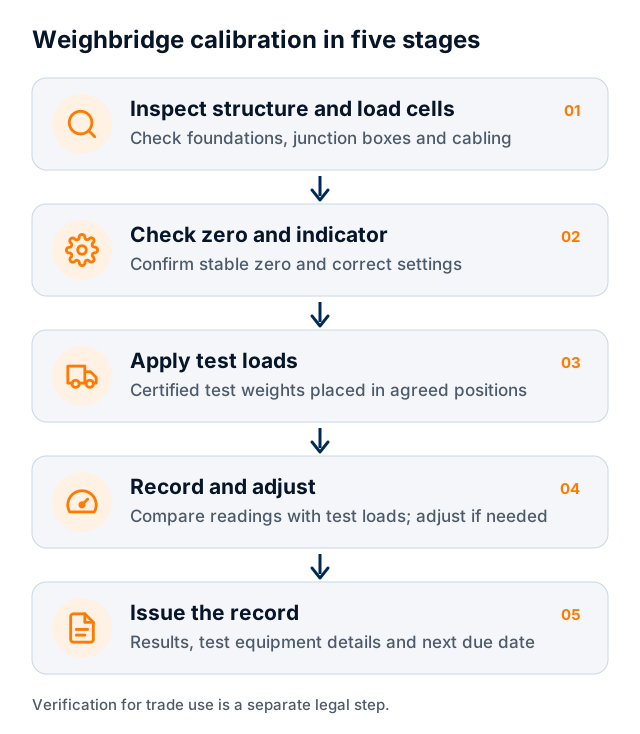
  1. Inspect the structure. We check foundations, deck modules, end walls, drainage and debris under the deck.
  2. Check load cells and cables. Next, we test each load cell, junction box and cable for damage and moisture.
  3. Check the indicator. Then we confirm zero stability, configuration and settings.
  4. Apply test loads. Certified test weights, often carried by a test unit vehicle, are placed at defined positions along the deck.
  5. Record and adjust. We compare readings with known loads, adjust if needed and repeat.
  6. Issue the record. Finally, you receive results, test equipment details and the next due date.
Five stages of a weighbridge calibration
Weighbridge calibration combines inspection, test loads and clear records.

Meanwhile, common weighbridge faults include water in junction boxes after rain, lightning damage to load cells and indicators, debris trapped under the deck, damaged cables from rodents and cracked foundations. Our team diagnoses these systematically and repairs what can be fixed on site.

Pressure gauge on calibration equipment

Weighing

How often should a weighbridge be calibrated?

Busy weighbridges handling many trucks a day often need calibration every three to six months, plus regular checks with a known reference vehicle. Lightly used weighbridges may manage with longer intervals. Calibrate after any repair, load cell replacement or major storm damage. Weighbridges used for trade must also pass verification by county weights and measures inspectors, usually annually.

Support and maintenance

Weighbridge installation support

We will tell you clearly which parts we deliver directly and where a specialist civil contractor or the equipment manufacturer must lead.

Reference vehicle checks between calibrations

Between formal visits, a simple routine catches most problems. Choose a reference vehicle, such as a company truck with a stable load, and weigh it at the start of each week. Record the reading. If the weight changes beyond a small, agreed limit, call for a check before trucks pass over a faulty deck. In addition, watch for zero drift at the start of the day and for different readings when a truck stops in a different position. Both often point to a load cell or debris problem.

These checks cost nothing but a few minutes. However, they protect the accuracy of every ticket in between weighbridge calibration visits, and they give inspectors and customers confidence that you manage the instrument carefully.

Managing disputes

Disputes over weights are common, especially for agricultural intake and quarry products. Good practice reduces them. For example, print clear tickets with gross, tare and net weights, keep camera images of each truck on the deck, record which operator handled the weighment and keep calibration records ready to show. When a supplier or customer questions a weight, you can then show evidence rather than argue. Many disputes end quickly when both sides see the photo and the calibration history.

Weighbridge Services

Software and tickets

Also, modern weighbridge software records each weighment with vehicle registration, driver, product, supplier or customer, gross, tare and net weights. It prints tickets, prevents tampering and produces daily reports. In addition, it can connect to accounting or stock systems.

We often add CCTV cameras that capture each truck on the deck, and number plate recognition that fills in the registration automatically. These steps reduce disputes and fraud. See our CCTV installation and parking management and ANPR pages for how cameras work.

Weighing

Protecting the weighbridge between calibrations

Because a weighbridge sits outdoors for decades, protection matters:

  • surge protection on load cell cables and indicator power;
  • proper earthing of the deck and electronics;
  • drainage that keeps pits dry;
  • regular cleaning under and around the deck;
  • rodent protection for cables;
  • a UPS for the indicator and computer, see our UPS power backup page.

Weighing

Choosing a weighbridge site

For new weighbridges, the location affects accuracy and traffic for decades. The ground must be firm and well drained, with straight, level approaches long enough for the longest trucks. In addition, the operator's office should have a clear view of the deck, and trucks should not need to reverse across busy roads. Power, data and lightning protection also need planning from the start. Getting these basics right avoids many of the faults we see on older installations, such as flooded pits and cracked end walls.

Rules and standards

Weighbridges used for trade fall under the Weights and Measures Act and require verification by county weights and measures inspectors. Separately, road authorities such as the Kenya National Highways Authority run axle-load enforcement weighbridges on highways. Private weighbridges help operators avoid overloading fines by checking loads before trucks leave site.

Weighing

Weighbridge calibration for Kenyan sectors

  • Quarries and construction: ballast, sand and cement weighed in and out.
  • Agribusiness: grain, sugarcane, tea and produce intake.
  • Manufacturing: raw material receipts and finished goods dispatch.
  • Recycling and scrap: incoming material purchases.
  • Logistics yards: checking loads before trucks enter public roads.

Weighbridge calibration cost factors

As a result, costs vary with weighbridge size, condition, access for test equipment, the number of load cells and any repairs found. Calibration requires heavy test weights, so travel and logistics affect the price. We quote after understanding the weighbridge and its history.

Training operators for accurate weighbridge calibration results

Operators control the accuracy of every ticket, so training pays off quickly. In fact, many apparent calibration problems turn out to be handling problems. We show them how to check zero before each truck, ensure the whole vehicle sits on the deck, avoid weighing while trucks move, record tare weights correctly and report damage. We also cover what to do during a power cut and how to handle disputes politely.

Weighbridge Services

Weighbridges are part of a wider weighing setup. See our weighing scale calibration, industrial weighing systems and industrial weighing and calibration pages.

To discuss weighbridge calibration, repair or installation support, request a quote with the weighbridge size, make and current problems.

Get started

Book a site survey

Tell us about your site and an engineer will call you back within one working day to discuss your needs and arrange a visit.

  • Clear, itemised written quote
  • Security, network, fire and power from one team
  • Support and maintenance after handover

Prefer to talk? Call +254 184 379 590

We reply within one working day. Or call +254 184 379 590.

Frequently asked questions

How often should a weighbridge be calibrated?

Busy weighbridges often need calibration every three to six months, with regular checks using a known reference vehicle in between. Calibrate after repairs, load cell replacement or storm damage. Weighbridges used for trade also need verification by county weights and measures inspectors, usually yearly.

Pit or pitless weighbridge: which is better?

Pit weighbridges save space and give a level approach, but need good drainage and regular pit cleaning. Pitless weighbridges install faster and are easier to clean, but need room for ramps. The right choice depends on space, ground conditions and traffic.

Can you add cameras to our weighbridge?

Yes. Cameras can capture each truck on the deck and attach images to the weighment ticket. Number plate recognition can fill in the registration automatically. This reduces disputes and helps prevent fraud.

Why does our weighbridge give different readings in the rain?

Water in junction boxes or load cell cables, or a flooded pit, often causes unstable readings after rain. Debris under the deck can also shift. We inspect, dry and reseal connections, clear drainage and recalibrate if needed.

Areas we serve

Installed and supported across Kenya

Our Nairobi team travels to sites countrywide. Choose your town for local details.

Planning a project or fixing a fault?

Tell us about the site. We will arrange a survey, give you a clear written quote and explain the options in plain language.

CallWhatsAppAsk usQuote