Mon to Fri, 8:00am to 5:00pmUtalii Court, Gesora Road, Nairobi

+254 184 379 590+254 719 450 317 Altinfo@gstechguard.co.ke

LED walls · pixel pitch · content management

LED Screen Installation and Digital Signage

We handle LED screen installation in Kenya for receptions, churches, malls, showrooms, event halls and campuses, plus digital signage networks for menus, notices and adverts. We help you choose pixel pitch and size, build a safe frame, plan power and data, and set up content you can update remotely.

  • Pixel pitch matched to viewing distance
  • Rigid frames, clean power and ventilation
  • Content you can update from a laptop
Modern meeting room in Kenya, the kind of space fitted with screens during LED screen installation

A bright, well-placed screen catches attention in a way posters cannot. Churches use LED walls for lyrics and live video. Malls and showrooms use them for adverts. Receptions use digital signs to welcome visitors and share news. Restaurants use menu boards that change by time of day. However, a screen that is too coarse for its viewing distance, badly mounted or hard to update quickly becomes an expensive black rectangle. A good LED screen installation starts with the right questions, not the biggest panel.

This page explains how to choose pixel pitch and size, how we mount and power screens safely, how content management works, and when an LED wall or a regular display makes more sense.

LED Screens & Digital Signage

Choosing pixel pitch and size

First, pixel pitch is the distance between the centres of two neighbouring LEDs, measured in millimetres. Smaller pitch means more pixels, a sharper picture up close and a higher price.

Pixel pitch Comfortable minimum viewing distance Typical use
1.2 to 1.9 mm About 1.5 to 2.5 m Boardrooms, studios, premium receptions
2.5 to 3.9 mm About 3 to 4 m Churches, halls, showrooms, malls
4 to 6 mm About 5 to 8 m Large halls, stages, indoor events
8 to 16 mm 10 m and beyond Outdoor billboards and building facades

A simple rule: the minimum comfortable distance in metres is roughly the pixel pitch in millimetres, and the ideal distance is two to three times that. So a 3 mm screen looks good from about 6 to 9 metres. We measure your room and seating, then recommend the coarsest pitch that still looks sharp. That keeps costs sensible.

Size follows content. Text must be large enough to read from the back row, and video looks best at standard proportions such as 16:9. In addition, we check the brightness you need. Indoor screens need far less brightness than outdoor ones, and a screen that is too bright for a church can tire people's eyes.

Displays

LED wall or large display?

However, not every project needs an LED wall. Large LCD displays and video walls of joined LCD panels have their place.

  • Single large displays (up to about 100 inches) cost less and suit meeting rooms and small receptions.
  • LCD video walls offer fine detail but show thin lines between panels.
  • LED walls have no seams, scale to any size and stay bright in well-lit rooms.

For churches, halls and stages, an LED screen installation is usually the right choice. For a boardroom, a large display may be better value. We compare both honestly.

Conference microphone on a boardroom table with speakers

Power backup

Mounting, power and data

For outdoor screens, we add weather-rated cabinets, lightning protection and wind loading checks. Some outdoor advertising also requires county approval, so check with your county government before installation.

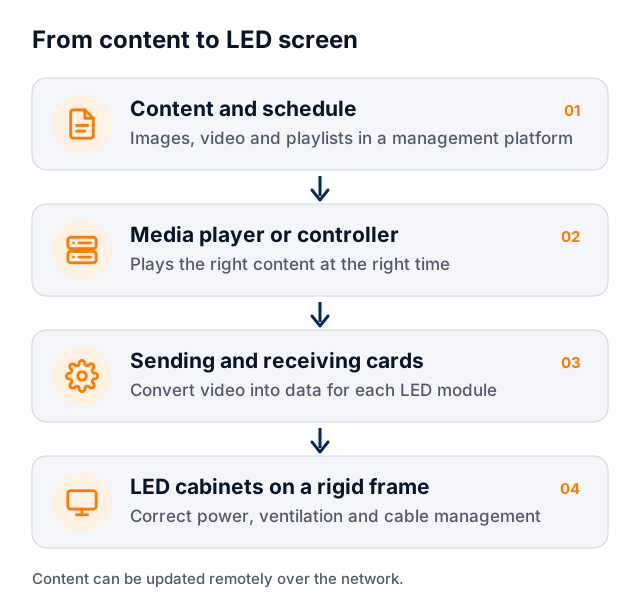
How content travels from a schedule to an LED wall
Content moves from a schedule to a media player, then to the LED cabinets.

Content management

Of course, a screen is only as good as what it shows. Content management software lets you upload images and video, build playlists, schedule content by time and day and update screens remotely.

For a single church or hall screen, the content might come from presentation software on a laptop, live video from cameras, or a video switcher. For signage across several branches, a cloud platform lets head office control every screen. We set up whichever approach suits your team, and we train the people who will manage it.

LED screen installation for churches and halls

Churches are among our most common clients. A typical church setup includes an LED wall behind or beside the stage, a video switcher for lyrics, slides and camera feeds, and confidence monitors so the worship team can see the lyrics too. We coordinate the screen with the sound system, because lyrics and audio must stay in sync. Our PA systems page covers the audio side.

Displays

Digital signage for businesses

Each screen runs a small media player connected to the network. As a result, you can change a price or a notice in minutes from a computer.

Networking

Networking and security for screens

Signage players sit on your network, so they need the same care as any other device. We place them on a separate network segment, change default passwords and keep software updated. Our network infrastructure services team plans cabling and Wi-Fi for each screen location.

How it works

Our LED screen installation process

  1. Survey. We measure the space, viewing distances, wall structure, power and lighting.
  2. Design. Next, we recommend pitch, size, brightness and controller, with a drawing of the final screen.
  3. Frame and power. Our team builds the frame and installs power and data cabling.
  4. Assembly. Then we mount cabinets, connect modules and calibrate colour and brightness.
  5. Content setup. We install the controller and content software and load your first content.
  6. Training. Finally, your team learns daily operation, content updates and basic fault checks.

Choosing a supplier

Before buying any LED wall, ask how quickly spare modules and power supplies arrive, who calibrates the screen after repairs and whether the controller software is easy for your team. Ask to see a screen the supplier installed at least a year ago, so you can judge how it has aged. Because LED walls are long-term investments, after-sales support matters as much as the purchase price.

Maintenance

Also, LED screens last many years with simple care. We recommend regular checks of modules, power supplies, fans and data connections, plus cleaning with the right materials. Keep a few spare modules from the same production batch, since colour can vary between batches. We can store and track those spares for you.

Planning for brightness, colour and comfort

Screens behave differently once installed. A wall that looks perfect in a dark warehouse can look washed out under strong windows, while one that looks right at noon can glare at night. So we set brightness profiles that change with the time of day, and we calibrate colour across all cabinets for an even picture. In churches and halls, we also check how the screen looks on camera, because live streams can show flicker that the eye does not see. Choosing a suitable refresh rate solves that problem.

LED screen installation cost factors

Costs depend on pixel pitch, screen size, indoor or outdoor rating, frame and structural work, controller and video processing, content software licences and installation height. Finer pitch drives cost up quickly, which is why matching pitch to viewing distance saves so much money. We provide options at two or three price points after the survey.

LED Screens & Digital Signage

LED screens often join wider AV projects. Our conference room AV page covers meeting rooms, and our background music systems page covers sound for retail and hospitality. Outdoor signage rules vary by county; the Nairobi City County site lists the relevant permits for the capital.

To plan an LED screen installation for your church, business or venue, request a site survey.

Get started

Book a site survey

Tell us about your site and an engineer will call you back within one working day to discuss your needs and arrange a visit.

  • Clear, itemised written quote
  • Security, network, fire and power from one team
  • Support and maintenance after handover

Prefer to talk? Call +254 184 379 590

We reply within one working day. Or call +254 184 379 590.

Frequently asked questions

What pixel pitch do I need?

Match pitch to the closest viewing distance. As a rough guide, the minimum comfortable distance in metres equals the pitch in millimetres, and the ideal distance is two to three times that. Churches and halls often use 2.5 to 3.9 mm, while boardrooms need finer pitch and outdoor billboards use much coarser pitch.

Can we update content ourselves?

Yes. We set up content software that lets you upload images and video, build playlists and schedule content from a laptop. For signage across several branches, a cloud platform lets head office update every screen remotely. We train your team during handover.

Do LED screens need special power?

LED walls need correctly sized circuits, surge protection and good earthing, especially for large screens. We plan the power with a qualified electrician and add a UPS for the controller where outages are common, so the screen restarts cleanly.

How long does an LED screen last?

Quality indoor LED screens often run for many years with routine care, and LED modules are usually rated for tens of thousands of hours. Brightness slowly falls with age. Regular checks, good ventilation and spare modules from the same batch keep the screen looking even.

Areas we serve

Installed and supported across Kenya

Our Nairobi team travels to sites countrywide. Choose your town for local details.

Planning a project or fixing a fault?

Tell us about the site. We will arrange a survey, give you a clear written quote and explain the options in plain language.

CallWhatsAppAsk usQuote