Mon to Fri, 8:00am to 5:00pmUtalii Court, Gesora Road, Nairobi

+254 184 379 590+254 719 450 317 Altinfo@gstechguard.co.ke

Costs and pricing

Structured cabling cost per point in Kenya: what is included

What structured cabling cost per point means in Kenya, what a fair price includes, how CAT6 and CAT6A compare, and the extras such as racks, containment and testing that change the total.

Technician testing a data point, part of structured cabling cost per point

Quick answer

In 2026, a tested CAT6 data point in Kenya typically costs KSh 4,500 to 8,000, and a CAT6A point KSh 7,000 to 12,000. A fair price includes the outlet, cable, patch panel port, a share of containment, labelling and testing. Racks, switches, long routes and after-hours work are usually extra.

Structured cabling cost per point is the most common way installers price office networks in Kenya. It is a useful measure, yet it can also hide big differences. One supplier's "point" may include tested cable in trunking with a labelled patch panel port, while another's may be loose cable and an outlet. This guide explains what a fair price includes, gives indicative 2026 ranges and shows how to compare quotes. For installation, see our structured cabling service, part of our network infrastructure services.

Costs and pricing

What structured cabling cost per point includes

In short, a point is a complete, tested link, not just a length of cable.

Costs and pricing

Indicative structured cabling cost per point for 2026

Item Typical scope Indicative range (KSh)
CAT6 data point Outlet, panel port, cable, containment share, testing 4,500 to 8,000 per point
CAT6A data point As above with CAT6A components 7,000 to 12,000 per point
Network cabinet 12U to 42U rack with patch panels and power strip 25,000 to 180,000
Fibre backbone link Per link, depending on length and civil work Quoted after survey

These ranges are before VAT. Moreover, they assume normal office conditions. In contrast, long routes, concrete coring, high ceilings or night work increase the structured cabling cost per point. Our security systems price guide lists other ranges.

Costs and pricing

What moves the structured cabling cost per point

Cable category

CAT6 suits most offices today. CAT6A supports higher speeds over the full distance and resists interference better, though it is thicker, costs more and takes longer to install. Therefore, choose CAT6A where you expect high-speed equipment or a long lease.

Cable length and route

Points far from the rack use more cable and more containment. Similarly, routes through risers, across floors or around obstacles take longer. As a result, a large floor with one rack in a corner may cost more per point than a compact office.

Containment

Trunking, conduit and tray protect cable and keep the office tidy. However, they add material and labour. Exposed routes in warehouses or older buildings often need more containment than offices with suspended ceilings.

Building condition

Finished buildings with closed ceilings and occupied desks are harder to work in than empty shells. In addition, solid walls and slabs may need coring. Consequently, early planning during fit-out keeps costs lower.

Working hours

Occupied offices often need work after hours or at weekends, which raises labour costs. Some Nairobi office towers also limit when contractors may work.

Quantity

Larger projects usually have a lower cost per point, because setup, rack work and testing equipment spread across more points.


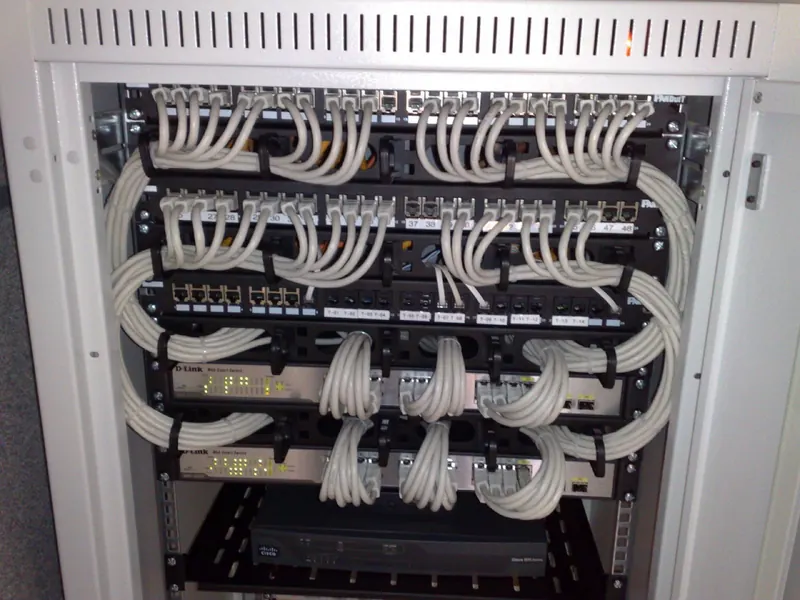
Patch panel and switches in a rack
Patch panel ports are part of the structured cabling cost per point.

Costs and pricing

Extras that are usually priced separately

Some items are not part of each point, yet they belong in the total budget.

Extra Why it matters
Rack or cabinet Houses patch panels, switches and the router
Network switches Connect points to the network, often with PoE
UPS for the rack Keeps the network running during outages
Fibre backbone Links racks on different floors or buildings
Wi-Fi access points Use ceiling points but are separate equipment
Removal of old cable Clears ceilings and trunking
Drawings and documents As-built plans and test results

Therefore, when you compare quotes, add these extras to the point price before deciding.

Costs and pricing

Structured cabling cost per point: example budget

Consider a 30-person office with two points per desk, plus points for printers, access points and cameras.

That gives 84 CAT6 points. At KSh 4,500 to 8,000 each, the cabling would cost about KSh 378,000 to 672,000. A rack, patch panels and cable management add roughly KSh 40,000 to 90,000. Switches, a UPS and Wi-Fi equipment then come on top, depending on the brands chosen. This example shows why a structured cabling cost per point is only the starting point for a network budget.

Costs and pricing

Comparing structured cabling cost per point quotes

Quotes become easier to compare once you ask the same questions of every supplier.

A low structured cabling cost per point often means something is missing, such as testing, containment or patch panel ports. In contrast, a complete, tested installation usually lasts the full life of the office without trouble.

Keeping structured cabling cost per point reasonable

First, plan cabling during fit-out, before ceilings and partitions close. Second, place the rack near the centre of the office to keep runs short. Third, agree on a realistic point count with modest spares rather than doubling every desk. Finally, reuse sound containment where it exists.

On the other hand, avoid saving money on cable quality, testing or labelling. These shortcuts lead to faults that cost far more to trace later.

Maintenance and lifetime value

Good cabling usually outlasts every switch, computer and phone connected to it. In fact, a well-installed CAT6 or CAT6A system often serves an office for 10 to 15 years. As a result, the true structured cabling cost per point is spread over many years of use, which makes quality far more important than a small saving at the start. Meanwhile, cabling needs little maintenance. Nevertheless, keep the rack tidy, replace damaged patch leads, update labels after moves and retest any point that gives trouble. In addition, keep the as-built drawings and test results with your IT records, because they save hours of tracing when a fault appears.

Cabling for security and building systems

Today, cabling carries far more than computer data. For example, cameras, access control readers, intercoms, Wi-Fi access points, IP phones, digital signage and even lighting controls may all use network cable. Therefore, include these in the point count from the start. Points for cameras and access points often sit in ceilings or on outside walls, so they may cost a little more to install. Nevertheless, adding them during the main project is much cheaper than returning later. See our CCTV installation page for camera cabling.

Office moves and phased projects

When a company moves offices, cabling often becomes urgent. Ideally, however, cabling starts weeks before the move, while ceilings are open and desks are not yet in place. In addition, phased projects can spread cost. For example, cable the main floor first and an expansion area later, as long as the rack has space for the extra patch panels. In this way, you avoid paying for points you will not use for years.

Standards and quality

Professional installers follow recognised cabling standards for distances, bend radius, separation from power and testing. Bodies such as TIA publish these standards. So ask which standard the installer follows and request test results that show each link passing. Our structured cabling checklist lists every item to confirm before you sign.

Getting a firm price

A short site survey turns an indicative structured cabling cost per point into a firm quote. Before the visit, prepare a floor plan with desk positions, note printers, cameras and access points, and confirm when the installer may work. To get started, request a cabling survey.

Get started

Book a site survey

Tell us about your site and an engineer will call you back within one working day to discuss your needs and arrange a visit.

  • Clear, itemised written quote
  • Security, network, fire and power from one team
  • Support and maintenance after handover

Prefer to talk? Call +254 184 379 590

We reply within one working day. Or call +254 184 379 590.

Frequently asked questions

How much does structured cabling cost per point in Kenya?

In 2026, a tested CAT6 point typically costs KSh 4,500 to 8,000 and a CAT6A point KSh 7,000 to 12,000, including outlet, cable, patch panel port, containment share and testing. Racks, switches and after-hours work are usually extra.

Should we choose CAT6 or CAT6A?

CAT6 suits most offices and costs less. CAT6A supports higher speeds over the full distance and gives more headroom for the future. The choice depends on your equipment plans and how long you will stay in the office.

Do you provide test certificates for every point?

Yes. We test every permanent link with a certification tester and hand over the results, a labelled floor plan and a rack layout.

Why is one cabling quote much cheaper than another?

The cheaper quote may leave out containment, patch panel ports, labelling or testing, or it may use lower-grade cable. Compare what each point includes before comparing the price.

Planning a project or fixing a fault?

Tell us about the site. We will arrange a survey, give you a clear written quote and explain the options in plain language.

CallWhatsAppAsk usQuote